

Get your science and technology news from South Korea
Provided by AGP
Australia High Purity Alumina Market 2026-2034 | Size, Price, Statistics, Outlook
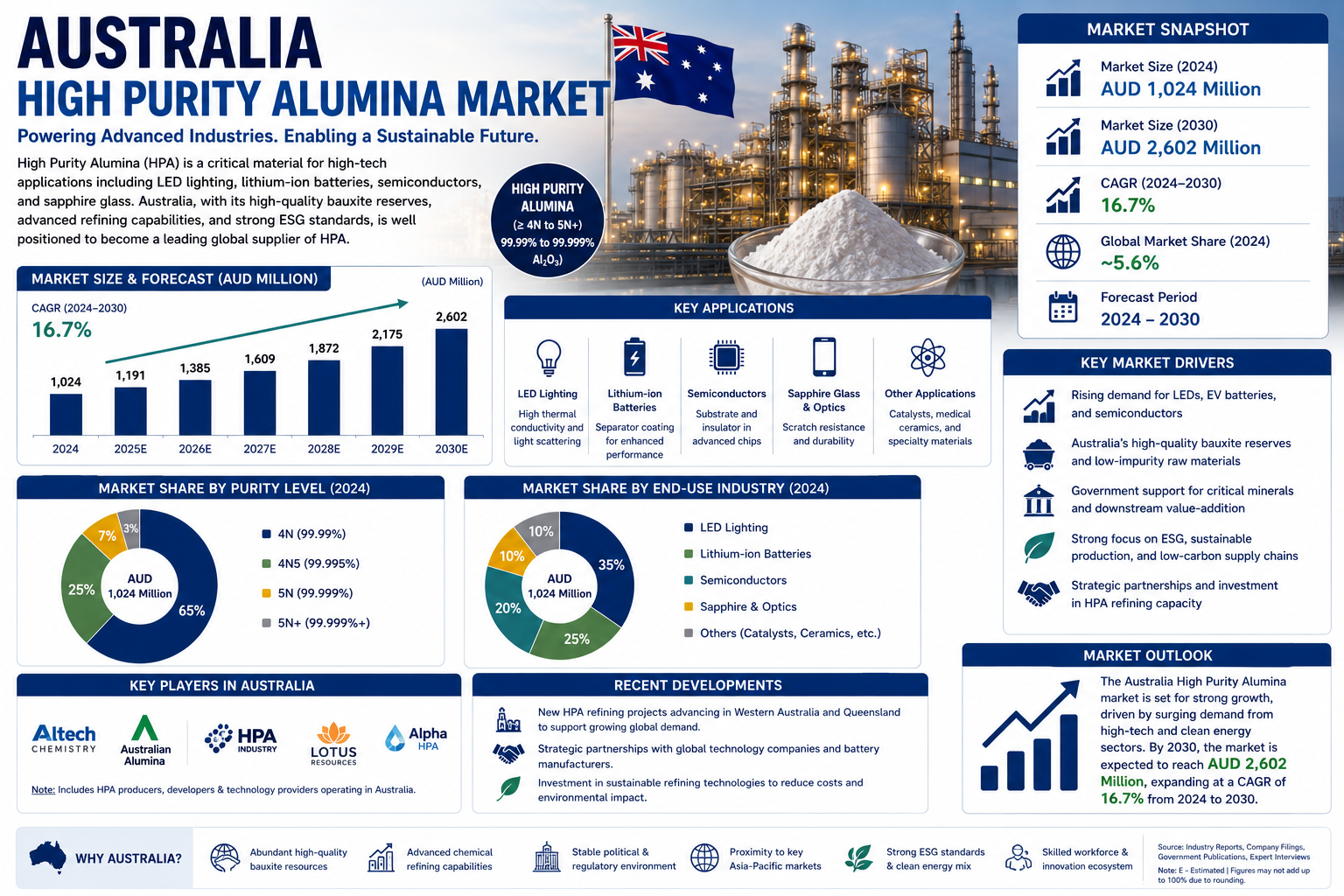
Australia High Purity Alumina Market
Australia high purity alumina market size was valued at USD 60.87 Million 2025, is projected to reach USD 302.21 Million 2034, at a CAGR of 19.49% 2026-2034.
AUSTRALIA, May 19, 2026 /EINPresswire.com/ --Market Overview
The Australia high purity alumina market size was valued at USD 60.87 Million in 2025 and is projected to reach USD 302.21 Million by 2034, growing at a compound annual growth rate of 19.49% from 2026-2034. The market is experiencing explosive growth as Australia is transitioning from a raw bauxite exporter to a high-value downstream high purity alumina (HPA) producer. This transformation is being driven by surging global demand for HPA across LED lighting, lithium-ion battery separators, sapphire substrates, and semiconductor components. With the Australian Government committing substantial funding through the Critical Minerals Facility and establishing a $1.2 billion Critical Minerals Strategic Reserve in the 2025-26 federal budget, the country is positioning itself as a globally significant HPA production centre that can serve the rapidly expanding clean energy and advanced electronics supply chains.
Why is Hot Today
The Australia high purity alumina market is commanding extraordinary attention as the Australian Government is providing $400 million in new loans to Alpha HPA through Export Finance Australia to deliver the country's first large-scale high purity alumina processing facility in Gladstone, Queensland. This project, expected to create around 490 jobs during construction and more than 200 permanent positions, is set to become the world's largest single-site HPA refinery. The funding is being delivered through the Government's $4 billion Critical Minerals Facility, the Northern Australia Infrastructure Facility, and Export Finance Australia's Commercial Account. Additionally, the Critical Minerals Strategic Reserve, allocated $1.2 billion in the 2025-26 federal budget, is set to become operational from the second half of 2026, further reinforcing Australia's strategic position in the global HPA supply chain.
Market Summary
• The Australia high purity alumina market is witnessing remarkable expansion as the material is becoming a cornerstone of the global green energy transition, with HPA-coated separators being essential components in lithium-ion batteries used across electric vehicles, energy storage systems, and portable electronics, creating sustained demand from the rapidly growing battery manufacturing sector.
• The LED lighting industry is representing one of the largest application segments for high purity alumina, as HPA is serving as a critical phosphor substrate material that enables superior light output, colour consistency, and energy efficiency in LED products, with global adoption of energy-efficient lighting driving consistent demand growth for ultra-pure alumina grades.
• The 5N purity grade (99.999%) is commanding the largest market segment share at approximately 46.3%, reflecting the growing demand for ultra-high purity materials in semiconductor fabrication, sapphire substrate production, and advanced electronics manufacturing where even trace impurities can compromise product performance and reliability.
• Sapphire glass production is emerging as a significant growth area for HPA consumption, with high purity alumina being used to manufacture synthetic sapphire for smartphone covers, smartwatch screens, automotive adaptive headlight lenses, and optical windows in defence and aerospace applications, driving premium pricing for the highest purity grades.
• Australian HPA producers are developing innovative low-carbon production processes that leverage the country's abundant renewable energy resources, with Andromeda Metals achieving a breakthrough in May 2025 by producing 99.9985% purity 4N HPA using a cost-effective and environmentally sustainable process that positions Australia as a competitive green HPA supplier.
• Geoscience Australia's Identified Mineral Resources report is showing a 14% increase in economic inventories for high purity alumina, reflecting growing exploration activity and resource delineation across the country as companies are developing new deposits and processing technologies to meet accelerating global demand.
Request for a sample report: https://www.imarcgroup.com/australia-high-purity-alumina-market/requestsample
How AI is Reshaping the Australia High Purity Alumina Market
Artificial intelligence is playing an increasingly transformative role in the Australia high purity alumina market, with nearly 70% of global mining companies already deploying AI for tasks such as predictive maintenance and real-time optimisation of processing circuits. In Australia, 60% of mines are preparing to adopt AI solutions, signalling broad industry momentum toward digitalisation that is directly benefiting HPA production efficiency, quality control, and resource optimisation across the value chain.
• AI-Driven Process Optimisation: Machine learning algorithms are revolutionising HPA refining processes by analysing particle size distributions, mineral compositions, and feedstock characteristics in real time to identify optimal separation and purification parameters. These systems are adjusting crushing, grinding, and chemical processing variables to maximise recovery rates and ensure consistent output quality at the ultra-high purity levels of 4N and 5N grades required by semiconductor, battery, and LED manufacturers.
• Predictive Quality Control: AI-powered analytical systems are monitoring production streams continuously, detecting trace impurities at parts-per-billion levels and providing real-time feedback to operators, enabling HPA producers to maintain the stringent 4N and 5N purity specifications demanded by LED, battery separator, and sapphire substrate manufacturers without costly batch rejection or reprocessing.
• AI in Mineral Exploration: Machine learning models are analysing geological datasets, satellite imagery, and geochemical survey results to identify new alumina-bearing deposits with the highest potential for economically viable HPA extraction, accelerating resource discovery and reducing the time and cost associated with traditional exploration methods across Australia's vast mineral-rich regions.
• Energy Management and Sustainability: AI-enabled energy management systems are optimising power consumption across HPA processing facilities, integrating renewable energy sources such as solar and wind to minimise carbon footprint while maintaining continuous high-temperature refining operations, supporting Australia's positioning as a producer of green, low-carbon high purity alumina.
• Automated Sorting and Grading: Computer vision and spectroscopic analysis systems powered by AI are enabling automated ore sorting that identifies and separates high-quality alumina feedstock from impurities at processing rates of thousands of fragments per minute, improving the efficiency and economics of the entire HPA production chain from raw material to finished product.
Market Trends and Insights
• The electrification of transport and the global energy storage revolution are creating unprecedented demand for high purity alumina, as HPA-coated battery separators are becoming essential components in next-generation lithium-ion batteries that power electric vehicles, grid-scale energy storage systems, and consumer electronics. Australia's domestic HPA production capacity is expanding rapidly to serve both Asia-Pacific and global markets, with multiple projects advancing from pilot-stage to commercial-scale operations that are expected to significantly increase the country's share of global HPA output.
• The semiconductor industry's rapid expansion is driving growing demand for ultra-high purity alumina substrates, with 5N grade HPA being used in the fabrication of electronic components, LED chips, and advanced optical devices, creating premium pricing opportunities for Australian producers capable of consistently delivering materials at the highest purity specifications.
• Australia's Future Made in Australia agenda is accelerating the development of downstream critical minerals processing capabilities, with the government's policy framework supporting the transition from raw material exports to value-added manufacturing that captures a larger share of the global HPA value chain and creates high-skilled employment opportunities in regional communities.
• Strategic partnerships between Australian HPA developers and global technology companies are strengthening, with joint ventures, offtake agreements, and technology licensing arrangements enabling Australian producers to secure long-term market access while leveraging international expertise in advanced purification and refining technologies. The partnership between FYI Resources and Alcoa Australia and Impact Minerals' Hipura joint venture exemplify this collaborative approach to building a commercially competitive Australian HPA industry.
• The growing importance of supply chain security is driving diversification away from Chinese-dominated HPA production, with Western nations and technology manufacturers actively seeking alternative, reliable sources in geopolitically stable jurisdictions. Australia, as a member of the Five Eyes alliance and a trusted trading partner with strong governance frameworks, is being positioned as a preferred HPA supplier for customers in North America, Europe, Japan, and South Korea seeking to de-risk their critical minerals supply chains.
• Innovations in low-carbon HPA production processes are creating competitive advantages for Australian producers, with companies developing proprietary technologies that utilise kaolin clay feedstock, solvent extraction methods, and renewable energy integration to produce high purity alumina at lower costs and with significantly reduced environmental impact compared to traditional production methods.
Market Growth Drivers
Government Investment and Critical Minerals Strategy: The Australian Government's commitment to developing a sovereign critical minerals processing capability is one of the most significant growth drivers for the high purity alumina market. The $400 million in government-backed loans to Alpha HPA for the Gladstone refinery, delivered through the $4 billion Critical Minerals Facility and the Northern Australia Infrastructure Facility, is establishing Australia's first world-scale HPA production facility that is expected to create around 490 jobs during construction and more than 200 permanent positions on completion. The $1.2 billion Critical Minerals Strategic Reserve, allocated in the 2025-26 federal budget and set to become operational from the second half of 2026, is further reinforcing the strategic importance of HPA as a nationally significant material. The broader Future Made in Australia policy agenda is supporting the transition from raw material exports to value-added downstream processing, attracting additional private sector capital and positioning Australia as a reliable, geopolitically stable source of high purity alumina for global technology and clean energy supply chains.
Surging Demand from Clean Energy and Electronics: The accelerating global transition toward electric vehicles, renewable energy storage, and advanced electronics is creating exponential demand for high purity alumina across multiple application segments. HPA-coated separators are essential components in lithium-ion batteries that power electric vehicles and grid-scale energy storage, while LED lighting manufacturers require ultra-pure alumina for phosphor substrates that enable superior light output and energy efficiency. The semiconductor industry is consuming growing volumes of 5N grade HPA for wafer fabrication and electronic component production, and sapphire glass manufacturers are using HPA for smartphone covers, smartwatch screens, and automotive adaptive headlight lenses. The global HPA market, valued at USD 3,064.6 million in 2025, is estimated to reach USD 15,950.5 million by 2034, reflecting the scale of multi-sector demand convergence that is driving exceptional growth and justifying significant capital investment in new Australian production capacity.
Technological Innovation and Cost Competitiveness: Australian companies are developing innovative production technologies that are making HPA manufacturing more cost-effective and environmentally sustainable. Andromeda Metals' breakthrough in producing 99.9985% purity 4N HPA using a low-carbon process, FYI Resources' partnership with Alcoa Australia for premium quality HPA development, Impact Minerals' acquisition of solvent extraction technology through the Hipura joint venture, and Altech Chemicals' expansion into medical and aerospace applications through its Advanced Ceramics acquisition are all demonstrating Australia's growing technological capabilities and broadening range of commercial opportunities. These innovations are enabling Australian producers to compete effectively against established Chinese suppliers while offering customers the added benefits of supply chain diversification, transparent governance, lower carbon intensity, and alignment with ESG requirements that are increasingly important to institutional investors and technology manufacturers worldwide.
Market Segmentation
The report has segmented the market into the following categories:
Breakup by Purity Level:
4N (99.99%)
5N (99.999%)
6N (99.9999%)
Breakup by Application:
LED Lighting
Lithium-Ion Battery Separators
Semiconductor Substrates
Sapphire Glass
Phosphor Coatings
Others
Breakup by Production Method:
Hydrolysis
Hydrochloric Acid Leaching
Others
Breakup by End-Use Industry:
Electronics and Semiconductors
Automotive and Electric Vehicles
Energy Storage
Lighting
Defence and Aerospace
Others
Breakup by Region:
New South Wales
Victoria
Queensland
Western Australia
Others
Key Players
Some of the key players in the Australia high purity alumina market that are mentioned in the report include Alpha HPA Limited, FYI Resources Limited, Altech Chemicals Limited, Andromeda Metals Limited, Impact Minerals Limited, Alcoa Corporation, Sumitomo Chemical Co. Ltd., Sasol Limited, Nippon Light Metal Holdings Company Ltd., and Baikowski SAS, among others. These companies are competing through innovative production technologies, strategic partnerships, government-backed financing, and expansion into high-value application segments to capture growing demand across the clean energy and advanced electronics supply chains.
Recent News and Developments
• May 2025: Andromeda Metals is achieving a significant breakthrough by producing 99.9985% purity 4N high purity alumina using a cost-effective, low-carbon production process, demonstrating Australia's growing technological capabilities in advanced HPA manufacturing and establishing a competitive green production pathway.
• April 2025: The Australian Government is announcing $400 million in new loans to Alpha HPA through Export Finance Australia, the Northern Australia Infrastructure Facility, and the Critical Minerals Facility to support the construction of Australia's first world-scale HPA processing facility in Gladstone, Queensland, expected to create 490 construction jobs and over 200 permanent positions.
• April 2025: Impact Minerals is securing a 50% joint venture stake in Hipura for USD 2.2 million, acquiring solvent extraction technology and a nearly completed pilot plant that strengthens Australia's domestic HPA processing capabilities and provides a pathway to commercial-scale production.
• April 2025: The Australian Government is committing $1.2 billion to establish a Critical Minerals Strategic Reserve in the 2025-26 federal budget, with the reserve set to become operational from the second half of 2026, reinforcing the strategic importance of high purity alumina and other critical minerals to national economic security.
• March 2025: FYI Resources is advancing its partnership with Alcoa Australia to develop premium quality high purity alumina, leveraging Alcoa's established alumina processing expertise and FYI's innovative HPA purification technology to create a commercially competitive production pathway for the Australian market.
• February 2025: Altech Chemicals is acquiring controlling interest in Advanced Ceramics, expanding its high purity alumina portfolio into medical and aerospace applications and demonstrating the broadening range of end-use markets that are driving demand for ultra-pure alumina materials produced in Australia.
Browse the full report with TOC & List of Figures: https://www.imarcgroup.com/australia-high-purity-alumina-market
Note: If you need any specific information that is not covered currently within the scope of the report, we will provide the same as a part of customization.
Other Report by IMARC Group
Australia Calcium Chloride Market 2026: https://www.imarcgroup.com/australia-calcium-chloride-market
Australia White Cement Market 2026: https://www.imarcgroup.com/australia-white-cement-market
Australia Aluminum Alloys Market 2026: https://www.imarcgroup.com/australia-aluminum-alloys-market
Australia Wood Plastic Composites Market 2026: https://www.imarcgroup.com/australia-wood-plastic-composites-market
Australia Lubricants Market 2026: https://www.imarcgroup.com/australia-lubricants-market
About Us
IMARC Group is a global management consulting firm that helps the world's most ambitious changemakers to create a lasting impact. The company provide a comprehensive suite of market entry and expansion services. IMARC offerings include thorough market assessment, feasibility studies, company incorporation assistance, factory setup support, regulatory approvals and licensing navigation, branding, marketing and sales strategies, competitive landscape and benchmarking analyses, pricing and cost research, and procurement research.
Contact Us
IMARC Group
134 N 4th St. Brooklyn, NY 11249, USA
Email: sales@imarcgroup.com
Tel No: (D) +91 120 433 0800
United States: +1-631-791-1145
Allan Baker
MAPEX INDUSTRIES
+1 631-791-1145
email us here
Legal Disclaimer:
EIN Presswire provides this news content "as is" without warranty of any kind. We do not accept any responsibility or liability for the accuracy, content, images, videos, licenses, completeness, legality, or reliability of the information contained in this article. If you have any complaints or copyright issues related to this article, kindly contact the author above.
